
TRIGGER
Use this as a simple, hands-on way to help kids remember that Jesus calls us to forgive, even when it is hard.
Materials
Steps
Simple Application
Connect the activity to a verse such as Ephesians 4:32 (be kind, tenderhearted, forgiving one another) or Colossians 3:13.
Explain that just as they can feel the rock in their hand, God wants the truth about forgiveness to be something they “carry” with them every day—choosing to let go of anger and show grace like Jesus.
Materials
- Smooth stones (one per child)
- Acrylic paint or paint markers
- Paintbrushes
- Paper plates or scrap paper to protect tables
- Optional: clear sealer (spray or Mod Podge) to protect the paint
Steps
- Give each child a smooth stone and set out paints/markers and brushes.
- Ask them to paint the word “Forgive” on the stone, and let them add colours, hearts, crosses, or other designs around the word.
- While they paint, gently lead a discussion:
- “Is it always easy to forgive someone who hurt you?”
- “Why does Jesus still ask us to forgive?”
- “How has someone forgiven you before?”
- When the stones are dry, encourage kids to keep their “forgiveness rock” somewhere they can see it (by their bed, in a pocket, on a desk) as a reminder to forgive others as God has forgiven them.
Simple Application
Connect the activity to a verse such as Ephesians 4:32 (be kind, tenderhearted, forgiving one another) or Colossians 3:13.
Explain that just as they can feel the rock in their hand, God wants the truth about forgiveness to be something they “carry” with them every day—choosing to let go of anger and show grace like Jesus.

CRAFT
Use this as a visual reminder that forgiveness comes from the heart and often involves our hands—choosing kind, healing actions instead of hurt.
Materials
Steps
Simple Application
Explain that the connected handprints forming a heart show how forgiveness flows from a heart that loves like Jesus and reaches out with open hands instead of closed fists. Invite children to think of someone they may need to forgive and silently ask God to help them show that kind of “forgiving heart” this week.
Materials
- Construction paper (one sheet per child)
- Pencil
- Scissors
- Glue (if mounting on another page or a poster)
Steps
- Fold a piece of construction paper in half lengthwise (like a long card).
- Place the child’s hand on the folded paper so that the thumb and index finger cross over the folded edge slightly.
- Use a pencil to trace around the hand, making sure the thumb and index finger lines go off the folded edge.
- Carefully cut out the handprint through both layers, but do not cut along the folded edge between the thumb and index finger. This is what will keep the two hands connected.
- Gently unfold the paper to reveal a heart shape formed in the center by the two symmetrical handprints.
- In the center of the heart, write the word “Forgiveness.”
- Optional: Glue the heart-hands onto another sheet of paper or a class poster and let children decorate around it with words or pictures of ways they can show forgiveness.
Simple Application
Explain that the connected handprints forming a heart show how forgiveness flows from a heart that loves like Jesus and reaches out with open hands instead of closed fists. Invite children to think of someone they may need to forgive and silently ask God to help them show that kind of “forgiving heart” this week.

GAME
Use this as a drama/mime game to help kids think about what it means to be brave and stand up for God like Stephen did in the book of Acts.
Materials
Preparation
Activity Steps
Simple Application
After several mimes, discuss questions like:
Encourage children to remember that standing up for God often means choosing what is right and loving, even when others may not agree.
Materials
- Slips of paper
- Crayons or pens
- Hat, bowl, or small bag
Preparation
- On each slip, write (or let the kids help write) simple “brave choice” scenarios, such as:
- A friend is being teased and you choose to stand up for them.
- Someone asks you to cheat on a test and you say no.
- Friends laugh at you for believing in Jesus, but you still talk about Him kindly.
- Fold the slips and place them in the hat or bowl.
Activity Steps
- Explain that Stephen stood up for God and spoke the truth about Jesus, even when it was tough and dangerous.
- Have one child come to the front, pick a slip of paper from the hat, and read it silently.
- The child mimes (acts out without talking) the situation and the brave, God-honoring response.
- The rest of the group guesses what is happening and how the person is “standing up for God.”
- Rotate through several children so that each gets a turn.
Simple Application
After several mimes, discuss questions like:
- “What makes it hard to do the right thing sometimes?”
- “How can the Holy Spirit help us be brave like Stephen?”
Encourage children to remember that standing up for God often means choosing what is right and loving, even when others may not agree.

CREATIVE SNACK
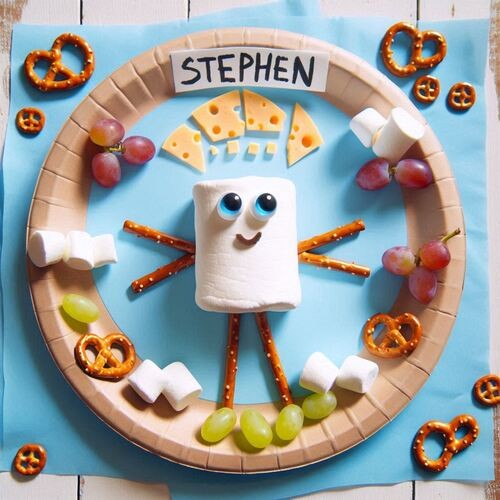
Use this as a simple “build the story on your plate” snack to review Stephen’s story and what he saw in heaven.
Ingredients / Materials
Steps
Simple Application
Before eating, ask:
Then invite kids to thank Jesus quietly in their hearts and enjoy the snack.
Ingredients / Materials
- Pretzel sticks and large marshmallows (to build Stephen)
- Grapes (to represent the stones)
- Cheese slices or cheese cubes (to represent the clouds / heaven)
- Paper plates and napkins
Steps
- Give each child a paper plate and a few pretzel sticks, a marshmallow, some grapes, and cheese.
- Show them how to make “Stephen” by using:
- A marshmallow for the head
- Pretzel sticks for the body, arms, and legs (they can stick into the marshmallow)
- Have the children place a few grapes around Stephen to represent the stones that were thrown at him.
- Let them place pieces of cheese at the top of the plate as “clouds” to picture heaven opening and Stephen seeing Jesus standing at the right hand of God.
- As they build, briefly retell Stephen’s story and emphasize that even when people were unkind and violent, Stephen kept his eyes on Jesus and forgave them.
Simple Application
Before eating, ask:
- “What do you think gave Stephen courage when things were scary?”
- “How can remembering Jesus help you be brave and forgiving?”
Then invite kids to thank Jesus quietly in their hearts and enjoy the snack.
OBJECT LESSON
Use this as a visual, science-style object lesson to show how forgiveness can “dissolve” bitterness and anger, like Stephen’s final prayer for his attackers in Acts 7.
Materials
Steps
1. Set the scene
2. Name the hurt
3. Prepare the “forgiveness tablet”
4. Dissolving the hurt
5. Wrap-up and reflection
Simple Application
Invite the children to pray silently or repeat a short prayer after you, asking God to help them forgive the person or situation they thought of.
Reassure them that forgiving does not mean saying the hurt was okay, but trusting God with the hurt and choosing not to hold onto anger.
Materials
- Clear glass or jar
- Warm water
- Alka-Seltzer tablets
- Small pieces of paper
- Pens or pencils
- Towel or tray under the jar (for spills)
Steps
1. Set the scene
- Briefly retell how Stephen’s accusers were angry and hateful, and how they hurt him badly.
- Explain that instead of staying angry, Stephen prayed, asking God to forgive them.
2. Name the hurt
- Ask children to quietly think of a time when someone hurt them, or when they hurt someone else.
- Give each child a small piece of paper and have them write one hurtful word or feeling (for example: “angry,” “left out,” “mean words,” “lied to”).
- Explain that these are the kinds of things we need to forgive, just as Stephen did.
3. Prepare the “forgiveness tablet”
- Have each child place their paper in the palm of their hand.
- Place an Alka-Seltzer tablet on top of the paper and explain: “We’re going to picture this tablet as a choice to forgive.”
4. Dissolving the hurt
- One at a time (or all together if you have enough jars), let the children drop their tablet (holding the paper under it) into the warm water.
- As it fizzes and dissolves, say something like: “When we forgive, God helps our anger and bitterness ‘break up’ and fade away. We may still remember what happened, but it doesn’t control us anymore.”
5. Wrap-up and reflection
- After the fizzing slows, hold up the jar and ask:
- “What happened to the tablet?”
- “How is that like what happens in our hearts when we choose to forgive?”
- Emphasize that forgiveness is a choice and a process, and that God can help us let go, just as Stephen did when he asked God not to hold his attackers’ sin against them.
Simple Application
Invite the children to pray silently or repeat a short prayer after you, asking God to help them forgive the person or situation they thought of.
Reassure them that forgiving does not mean saying the hurt was okay, but trusting God with the hurt and choosing not to hold onto anger.